



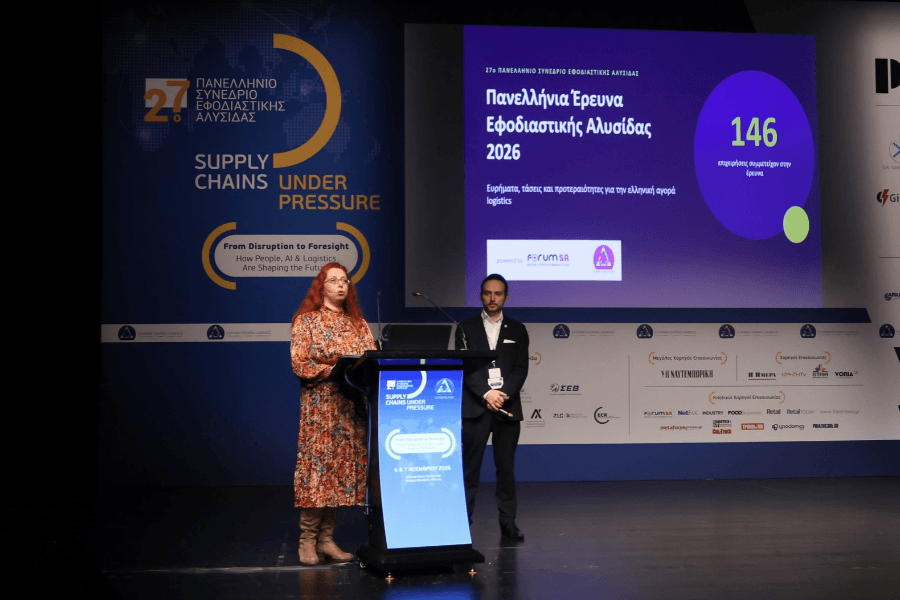
The main findings of the National Logistics Survey, powered by FORUM, were presented at the 27th Conference of the Hellenic Logistics Association (EEL), highlighting the challenges, needs and prospects of the Greek supply chain sector.
The survey results reveal a market that continues to show strong potential, despite ongoing pressures. Rising operating costs, workforce shortages, increasing demand for warehouse space and the need for faster digital transformation, are among the main challenges facing the logistics sector in Greece. Nevertheless, businesses remain optimistic about the market’s growth potential, identifying AI as one of the key drivers of change in the coming years.
The 27th Conference of the Hellenic Logistics Association took place on November 6-7, at Megaron The Athens Concert Hall, bringing together approximately 900 supply chain professionals. FORUM SA supported the event as one of its industry media sponsors through Supply Chain & Logistics Magazine.
The survey was conducted under the guidance of a Scientific Committee of university academics and was based on responses from 146 supply chain professionals. The findings were analyzed by the Department of Maritime Studies & Logistics at the University of Piraeus.
The results were presented by Evangelos Tsioumas, Assistant Professor of Quantitative Methods in Shipping at the University of Piraeus, and Mary Efthymiatou, Editor-in-Chief of Supply Chain & Logistics magazine.
The Findings in Numbers
Presenting the survey results, the speakers highlighted the following figures:
- 90.8% of the respondents identified fuel costs as the main obstacle in transportation.
- 87.2% reported an increase in logistics costs over the past two years.
- 63.6% operate warehouses at over 80% capacity or experience frequent bottlenecks.
- 85.4% face moderate or severe staff shortages.
- 41.4% still rely on Excel or basic ERP systems.
- 60.3% have no alternative-fuel vehicles in their fleets.
- 91.6% expect the market to grow over the next three years.
- 77.8% consider AI the technology with the greatest potential impact.
Five Strategic Priorities
To address current challenges and strengthen the Greek supply chain, five main areas of action were identified:
- Improving Energy Efficiency: Optimizing transport routes, investing in renewable energy sources and adopting electric vehicles, can help businesses reduce operating costs while improving sustainability.
- Strengthening Workforce Development: Efforts should focus on attracting drivers and warehouse staff, while providing continuous training to develop digital skills and support the changing needs of the industry.
- Making Better Use of Data and AI: Businesses need to move beyond basic ERP and WMS solutions towards integrated systems, advanced forecasting tools and AI-supported planning.
- Expanding Warehouse Capacity: Investing in modern warehouse facilities and automation can help reduce congestion, improve operational efficiency and address increasing storage demands.
- Developing Greece as a Logistics Hub: Improving road and rail networks, developing logistics centers and introducing investment incentives are essential steps towards establishing Greece as a major logistics hub.
The findings indicate that the logistics industry is entering a critical period, requiring businesses to demonstrate resilience and adapt to changing market conditions. Targeted investments and the adoption of more efficient, technology-driven operating models are becoming increasingly important for strengthening the competitiveness of Greek businesses.